Tikvah and the Sound of the Shofar: A Journey from Spiritual Desert to Seeking God

Hope can arrive as a whisper, but sometimes it comes as a sound that cuts through everything.
For me, that sound was the shofar.
Ten years ago, during the Feast of Trumpets, I heard the blast of a ram’s horn and something in me woke up. I had been living in what I can only call a spiritual desert. Dry. Distant. Tired. Not completely without belief, but without freshness. I knew enough about God to know I needed Him, yet I felt far from the nearness my soul was made for.
Then came that sound.
It was not polished like a song. It was ancient, raw, and commanding. The shofar did not entertain me. It interrupted me. It reached past the noise in my mind and touched a place I had almost stopped listening to.
That moment became a turning point. I did not understand everything that day. I still had questions. I still had wounds. I still had habits of wandering. But something changed. A new outlook began to form, one filled with hope and promise.
The Hebrew word for hope is Tikvah. It is more than a wish. It is a cord, an expectation, a waiting that reaches forward. Looking back now, I see that the sound of the shofar was tied to Tikvah in my life. It became a call out of dryness and into seeking God again.
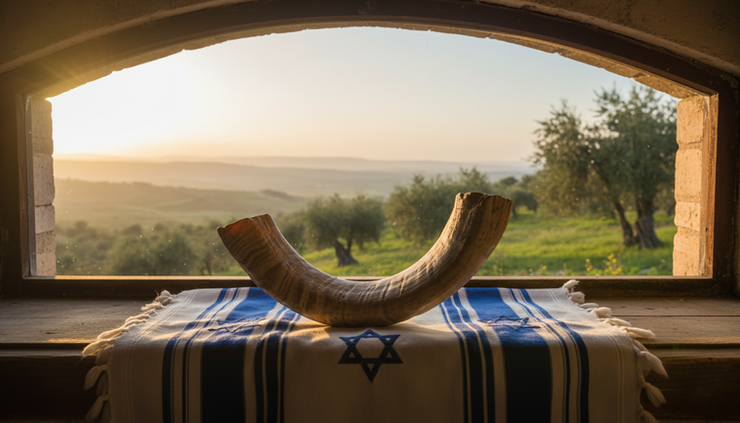
The shofar sounded like a call to wake up
The Feast of Trumpets, also known by many as Rosh Hashanah or Yom Teruah, carries a deep sense of awakening. The sound of the shofar is a call to attention. It gathers the heart. It announces that something holy is near.
That is what it felt like for me.
I was not sitting there with a perfect spiritual life, ready to receive a beautiful religious moment. I was dry. I was distracted. I had allowed distance to grow between my daily life and my desire for God. Prayer felt thin. Scripture felt far away. My soul felt like ground that had not seen rain in a long time.
Then the shofar sounded.
There are moments when God does not give a long explanation. He simply calls.
That sound felt like mercy. Not harsh mercy, but clear mercy. It was as if God was saying, “Wake up. Come back. There is still more. You are not finished. I am not finished with you.”
The shofar did not fix everything instantly. That matters to say. A spiritual desert is rarely crossed in one emotional moment. There were still days of struggle, silence, repentance, and learning. But the sound marked the beginning of movement.
Before that day, I had been surviving spiritually. After that day, I began seeking.
That difference matters.
Survival says, “I hope I make it through.”
Seeking says, “LORD, I want to know You.”
Survival keeps the head down.
Seeking lifts the eyes.
The shofar became, for me, a sign that God can still reach a person in the dry places. He can speak through sound, Scripture, memory, worship, silence, and creation. He knows how to find us when we feel hidden even from ourselves.
Tikvah is hope with a cord attached
The word Tikvah is beautiful because it carries the sense of hope, expectation, and waiting. It is not passive. It is not vague optimism. It is hope with tension in it, like a cord pulled tight between what is and what God has promised.
That picture helped me understand my own journey.
I did not feel instantly strong. I did not suddenly know how to pray for hours or walk in perfect discipline. I simply had a cord of hope again. It was enough to hold onto.
Sometimes that is where renewal begins.
Not with a grand plan.
Not with dramatic confidence.
Not with every answer.
Just a cord.
A small pull toward God.
A desire to open the Bible again.
A quiet prayer in the car.
A tear during worship.
A decision to attend gathering again, even when the heart feels tired.
A willingness to say, “LORD, I am dry, but I AM HERE.”
Tikvah gave language to what was happening inside me. Hope was not pretending the desert did not exist. Hope was believing the desert was not the end of the story.
The Bible often shows God meeting people in wilderness places. Moses encountered God while far from the palace. Israel learned dependence in the wilderness. Elijah heard the gentle whisper after exhaustion and fear.
The desert is not comfortable, but it can become holy ground.
That does not mean every dry season is easy to explain. Some are born from grief. Some from sin. Some from disappointment. Some from waiting too long without visible change. Some from carrying burdens no one else sees.
But God is not absent from the desert.
The shofar taught me that.
Tikvah helped me name it.

The spiritual desert did not have the final word
A spiritual desert can make the promises of God feel far away. It can dull the senses. It can make worship feel like memory instead of present reality.
I know that feeling.
There were times when I wondered why seeking God seemed easier in earlier seasons. I remembered moments of passion, clarity, and hunger. I remembered praying with confidence. I remembered feeling alive in faith. Then I looked at where I was and wondered how I had become so dry.
That question can bring shame if we let it.
But shame rarely leads us home. The kindness of God does.
The turning point came when I stopped treating dryness as proof that God was done with me. Instead, I began to see it as a place where He was inviting me to return. Not to perform. Not to impress anyone. Just to return. Teshuva. Repentance. Returning.
That return started small.
I paid attention to the ache in my heart instead of burying it.
I asked God to restore hunger for His presence.
I began to seek Him, not as a project, but as a Person.
The desert did not disappear overnight. There were still dry prayers. There were still distracted days. There were still moments when hope felt fragile. But the direction had changed. I was no longer walking deeper into distance. I was turning toward the Lord.
That is grace.
Grace is not only God forgiving the past. Grace is God giving us strength to take the next step toward Him.
For me, the shofar was a sound that broke through the fog. It reminded me that God still calls, still gathers, still awakens, still restores.
There is promise in that.
Not because the journey is easy, but because God is faithful.
Seeking God became a daily return
After that moment ten years ago, I became inspired to seek God in a deeper way. At first, seeking can seem like something large and impressive. Long prayers, perfect routines, and constant spiritual focus.
Real seeking has been humbler than that.
It has looked like returning again and again.
Some days, seeking God means opening Scripture before reaching for distraction.
Some days, it means whispering, “Help me,” because no other words come.
Some days, it means repenting quickly instead of hiding.
Some days, it means choosing gratitude when the heart wants to complain.
Some days, it means sitting quietly and letting God search what I cannot name.
The longer I walk this path, the more I believe seeking God is built through faithfulness, response. The shofar sounded once in that memorable way, but the call continues in daily life.
God calls through His Word.
He calls through conviction.
He calls through beauty.
He calls through people who speak truth with love.
He calls through the ache that tells us we were made for more than surface living.
He calls through silence, too.
That last one is hard. Silence can feel like absence. But sometimes silence becomes the space where desire grows. It teaches the soul to wait, to listen, to trust without rushing.
Tikvah lives there.
Hope is not always loud. Sometimes hope is the quiet decision to keep seeking God when feelings rise and fall. When people disapoint. When everyday life swams over you and you cant see the sky.
That has been one of the gifts of the last ten years. I have learned that spiritual hunger can be restored. I have learned that dry ground can receive rain. I have learned that God is patient with those who are learning to return.
I have also learned that remembrance matters.
When I remember the sound of the shofar, I remember the mercy of being called back. I remember that one moment can become a marker. I remember that God met me when I was dry, not only after I became strong but when I was weak.
That memory still gives me courage.

Hope sounds different after the desert
Hope before a desert can feel bright and simple. Hope after a desert often feels deeper. It has been tested. It has had to survive questions, silence, weakness, and waiting.
That kind of hope is precious.
It no longer depends only on emotion. It is rooted in the character of God. It says, “I have been dry before, and God still called me. I have wandered before, and God still drew near. I have felt empty before, and God still planted desire in me again.”
This is why Tikvah means so much to me now.
Hope is not a denial of hardship. It is a witness that God is present in the middle of it. Hope does not erase the memory of the desert. It redeems it.
The sound of the shofar remains connected to that hope in my heart. It reminds me of awakening. It reminds me of repentance. It reminds me of promise. It reminds me that God’s call is stronger than spiritual numbness.
Ten years later, I still see that moment as a beginning.
Not the beginning of perfect faith.
Not the beginning of a problem-free life.
The beginning of a renewed pursuit.
And maybe that is one of the most honest ways to describe a life with God. We hear. We respond. We stumble. We return. We grow. We wait. We hope.
Again and again, Tikvah becomes the cord in our hands.
Again and again, the Lord invites us to seek Him.

A promise for the road ahead
This first post begins with hope because that is where my journey began again. Not with certainty about every step, but with a call. Not with perfect understanding, but with desire. Not with a full map, but with Tikvah.
The sound of the shofar pulled me out of a spiritual desert and reminded me that God still speaks. Since then, I have been inspired to seek Him, to listen more closely, and to trust that dry seasons do not get the final word.
If there is one takeaway from this journey, it is this: when God calls, hope is already present.
It may begin as a sound.
It may begin as a prayer.
It may begin as a small ache in the soul that says, “Come back.”
Follow that call.
Hold the cord of hope.
Seek God one step at a time.
Comments